Practical self-defence for anyone who processes data. Not legal advice. Not a political statement. Just the framework, the tools, and the records that matter if questions ever arise.
Global coverage
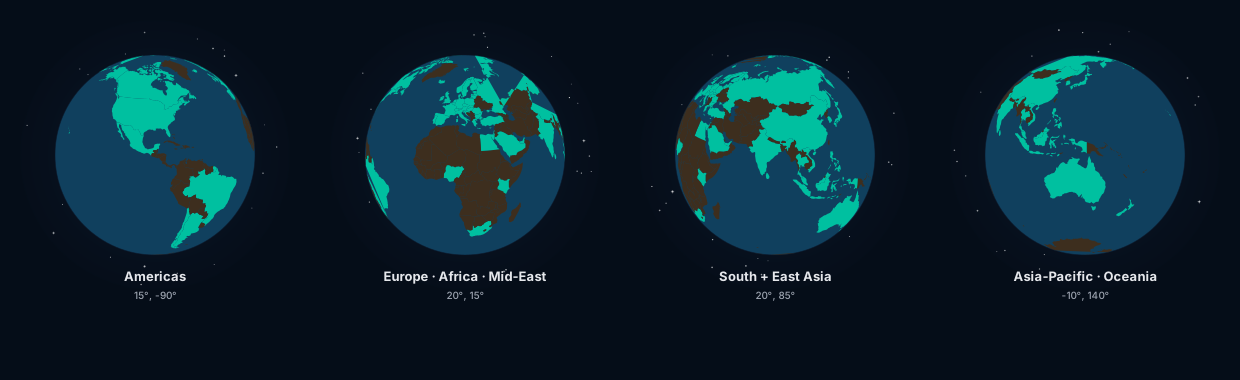
This guide covers ~24 data-protection regimes in detail and another 11 briefly, shown on the map below. Countries are coloured by the regulatory family their primary law belongs to. Uncovered countries are shown in muted slate — the methodology in this guide still applies, but you'll need to substitute your local law for the worked GDPR examples.
Four orthographic views — Americas · Europe/Africa/Mid-East · South + East Asia · Asia-Pacific/Oceania — together showing every jurisdiction on Earth.
Covered in this guide (60 countries — 24 in detail + 36 briefly or via EU/EEA)Not yet covered in detail — methodology still applies; swap your local law for the GDPR examples
You process data. Maybe client notes, collaborator emails, interview transcripts, a dataset of survey responses, your own coding history in an AI assistant — any information that could identify a specific person, including yourself. You're not a Fortune-500 corporation with a dedicated legal department. You're one person, or a small team, trying to understand what laws apply to what you're doing.
This guide exists because the structural question faced by solo developers is identical to the one faced by enterprises: which of my providers could be compelled to produce my data under a law other than the one that's supposed to protect it, and what do I do about that?
What this guide is not
Not legal advice. It summarises public law and regulator guidance. When your situation matters — contracts, litigation, enforcement — talk to qualified counsel.
Not a political statement. Every jurisdiction's laws exist for reasons its elected representatives considered legitimate. The goal here is factual clarity about how those laws interact, not judgment about which ones are "good" or "bad".
Not alarmist. The probability that any specific individual's data will be the subject of an extraterritorial production order is low. The probability that you should understand the framework anyway is high — because the understanding is what allows you to respond calmly if ever asked.
The core observation
Most people's data is protected by the data protection law of their jurisdiction. In the EU it's the General Data Protection Regulation (Regulation (EU) 2016/679, "GDPR"). It grants specific rights (Arts. 12-22), places obligations on anyone processing data (Arts. 24-43), and — critically for this guide — restricts when controllers may respond to data access requests from outside the EU (Art. 48).
At the same time, some providers that solo developers and small teams use every day — cloud APIs, code-hosting services, ML services — are incorporated in jurisdictions whose laws can compel them to produce data regardless of where the data physically sits. The US CLOUD Act (18 U.S.C. §2713) and the UK Investigatory Powers Act 2016 are the most commonly cited examples.
When data protected by one framework reaches a provider governed by another, the two frameworks interact. GDPR Art. 48 is written precisely for this interaction.
This guide uses GDPR as the primary example — but the methodology is global. Most major economies now have their own data protection regime: India's DPDPA (2023), China's PIPL + DSL (2021), Brazil's LGPD (2018), Russia's Federal Law 152-FZ (2006, heavily amended since 2015), Canada's PIPEDA, Australia's Privacy Act, Japan's APPI, South Korea's PIPA, and many more. The structural question is the same in every jurisdiction: which of my providers are subject to a foreign legal framework with extraterritorial reach, and what protective mechanism does my local law offer? Substitute your local law for "GDPR," your local supervisory authority for "EDPB/national DPAs," and the methodology — map your providers, minimise your data flow, document your actions — transfers directly.
Your jurisdiction shapes the analysis
The methodology of this guide — map your providers, minimise the data flow, document your actions — is universal. The specific protective mechanism you can invoke depends on which data-protection law you live under. Below is a deliberately concrete description of eight major jurisdictions, with the precise citations a lawyer would want.
European Union / EEA — GDPR
Primary law: Regulation (EU) 2016/679 ("GDPR"). Effective 25 May 2018. Applies in all EU and EEA states.
Lawful bases for processing — Art. 6: consent, contract, legal obligation, vital interests, public task, legitimate interests (six total).
Cross-border transfers — Chapter V (Arts. 44-50): adequacy decision, Standard Contractual Clauses, Binding Corporate Rules, derogations.
Extraterritorial-order shield — Art. 48: foreign court/administrative orders are not lawful grounds for transfer unless based on an MLAT or other international agreement.
Breach notification — Art. 33(1): supervisory authority within 72h of awareness; Art. 34: data subjects when high-risk.
United States — sectoral + state-level + extraterritorial reach
The US has no comprehensive federal data-protection law. The framework is a patchwork:
Sectoral federal: HIPAA (health), GLBA (finance), COPPA (children under 13), FCRA (credit), FERPA (education).
State comprehensive laws: CCPA + CPRA (California), CDPA (Virginia), CPA (Colorado), CTDPA (Connecticut), UCPA (Utah), and ~20 more enacted since 2023.
US CLOUD Act 2018 (18 U.S.C. §2713) — extraterritorial: compels US-incorporated providers to produce data regardless of storage location.
Enforcement: FTC + state Attorneys General. No federal DPA.
India — Digital Personal Data Protection Act 2023 (DPDPA)
Primary law: Digital Personal Data Protection Act, 2023 (Act No. 22 of 2023). Replaces the prior Sec. 43A regime under the IT Act. Implementation rules notified progressively from 2024 onwards.
Extraterritorial scope — Sec. 3(b): applies to processing of digital personal data outside India if in connection with offering goods or services to Data Principals within India.
Lawful processing: consent (Sec. 6) OR "certain legitimate uses" (Sec. 7 — limited closed list, narrower than GDPR's legitimate interests).
Cross-border transfers — Sec. 16(1): permitted by default, except to countries restricted by Central Government notification. The default is permissive — opposite of the GDPR default of "restricted unless adequacy/SCCs/derogations."
Significant Data Fiduciaries — Sec. 10: Government may designate organisations with extra obligations (DPO, DPIA, audits).
Enforcement: Data Protection Board of India (DPBI). Penalties up to ₹250 crore per instance.
Children's data — Sec. 9: verifiable parental consent required for under-18s.
Primary laws: Personal Information Protection Law (PIPL, 2021), Data Security Law (DSL, 2021), Cybersecurity Law (CSL, 2017). Applied together by the Cyberspace Administration of China (CAC).
Extraterritorial scope — PIPL Art. 3: applies to processing of personal information of natural persons in China outside Chinese territory when (i) for offering products or services to such persons, (ii) for analysing or assessing their activities, or (iii) other circumstances provided by laws.
Cross-border transfer mechanisms — PIPL Arts. 38-43: one of three required:
CAC security assessment (mandatory for "important data," CIIOs, large-volume processors)
Standard Contract (CAC SCCs, effective 2023, easier path for small/medium volume)
Personal information protection certification (third-party certification body)
Data localisation — PIPL Art. 40 + CSL Art. 37: Critical Information Infrastructure Operators (CIIOs) and processors handling "important data" must store such data in China; cross-border transfer requires security assessment.
DSL classifications: "general data," "important data," "core data." "Core data" near-impossible to transfer abroad. "Important data" catalogues being defined sector-by-sector.
Primary law: Lei Geral de Proteção de Dados Pessoais (LGPD) — Law No. 13.709/2018. Effective August 2020. Highly aligned with GDPR but with important divergences.
Lawful bases — Art. 7: ten bases (vs. GDPR's six). Includes consent, contract, legal obligation, public administration, research, legitimate interests, credit protection, plus regulated-profession-specific bases.
Subject rights — Art. 18: confirmation, access, correction, anonymisation, portability, deletion, information about sharing, revocation.
International transfers — Arts. 33-35: adequacy decision by ANPD, SCCs, BCRs, specific authorisation, or derogations (consent + a few others).
Extraterritorial scope — Art. 3: applies when processing occurs in Brazil, when offering services to people in Brazil, or when data was collected in Brazil.
Enforcement: Autoridade Nacional de Proteção de Dados (ANPD). Penalties up to 2% of revenue capped at R$50 million per infraction.
Russian Federation — Federal Law 152-FZ + State Duma amendments
Primary law: Federal Law No. 152-FZ "On Personal Data" (2006), heavily amended by the State Duma. Key amendments: FZ-242 (2014, data-localisation), Yarovaya laws (2016, telecom data retention), FZ-266 (2022, breach notification + scope).
Data-localisation — Art. 18(5) (FZ-242, 2014, effective 2015): when collecting personal data of Russian citizens, the operator must ensure recording, systematisation, accumulation, storage, modification, retrieval are performed using databases located on the territory of the Russian Federation.
Breach notification — FZ-266 (2022): notify Roskomnadzor within 24 hours of breach awareness, with follow-up within 72 hours.
Extraterritorial scope — Art. 1.1: applies to processing of personal data of Russian citizens by foreign operators offering goods/services in Russia or analysing/profiling such individuals.
Subject rights — Arts. 14-17: access, correction, blocking/deletion of unlawful processing, right to object.
Yarovaya Laws — Federal Laws 374-FZ + 375-FZ (2016): require telecom operators and ISPs to store metadata for 3 years and content for 6 months; require providers of "information dissemination services" to provide decryption keys to FSB.
Enforcement: Roskomnadzor (Federal Service for Supervision of Communications, Information Technology and Mass Media). Penalties up to ₽18 million for repeat data-localisation violations (FZ-572, 2024).
Primary law: Personal Information Protection and Electronic Documents Act (PIPEDA, 2000). Provincial laws apply in BC, Alberta (PIPA), and Quebec (Law 25 / Act 64).
Consent-based with reasonable-purposes carve-outs.
Quebec Law 25 (effective 2022-2024 in stages) significantly tightened obligations: consent-by-default, mandatory privacy impact assessments, data-portability rights, breach notification within "as soon as possible."
Reform in progress: Bill C-27 (Consumer Privacy Protection Act + AI and Data Act) introduced 2022, status pending.
Enforcement: Office of the Privacy Commissioner of Canada (federal); provincial commissioners for BC/AB/QC.
Thirteen Australian Privacy Principles (APPs) under Schedule 1, governing collection, use, disclosure, accuracy, security, access.
Notifiable Data Breaches scheme (Part IIIC, since 2018): notify OAIC + affected individuals "as soon as practicable" after assessing likely serious harm.
2024 Privacy Act Reform (first tranche enacted Dec 2024 as Privacy and Other Legislation Amendment Act 2024): introduces children's online privacy code, statutory tort for serious privacy invasions, automated decision-making transparency, increased penalties.
Cross-border: APP 8 — sender accountable for overseas recipient's compliance unless one of seven specified exceptions applies.
Enforcement: Office of the Australian Information Commissioner (OAIC). Penalties up to A$50M / 30% of adjusted turnover / 3× benefit (whichever greater).
Cross-border — IPP 12: must take reasonable steps to ensure overseas recipient has comparable safeguards. Standard wording mechanism via OPC-issued model clauses.
Privacy Commissioner has compliance-notice and access-direction powers; criminal penalties for some offences.
Enforcement: Office of the Privacy Commissioner (OPC).
Cross-border transfer — Art. 28: requires consent OR transfer to a country recognised by PPC as having adequate protection (e.g., EU, UK) OR contractual safeguards equivalent to APPI.
Pseudonymously processed information (kanyo-joho) — reduced obligations vs. personal information.
Enforcement: Personal Information Protection Commission (PPC). Criminal penalties for severe violations.
2020 amendments: mandatory breach notification (within 3 days to PDPC if significant harm OR ≥500 individuals affected); data portability; new offences for egregious mishandling.
Cross-border: transferring organisation must take steps to ensure recipient is bound to comparable standards.
Enforcement: Personal Data Protection Commission (PDPC). Penalties up to S$1M or 10% of annual turnover (whichever higher) post-2022.
Extraterritorial scope — Sec. 5: applies to processing outside Thailand offering goods/services to data subjects in Thailand or monitoring their behaviour.
Breach notification: within 72 hours to PDPC (Art. 37).
Cross-border: requires adequate protection in destination OR appropriate safeguards (BCRs, contractual clauses).
Enforcement: Personal Data Protection Committee (PDPC, under MDES — Ministry of Digital Economy and Society).
Vietnam — Decree 13/2023 on Personal Data Protection
Effective 1 July 2023. First comprehensive PDP regulation in Vietnam (full law expected 2025).
Strict consent requirements — written or electronic, separate from other consents.
Data Localisation: Decree 53/2022 + Cybersecurity Law 2018 — required for certain categories of data + offshore providers offering services in Vietnam.
Cross-border transfer — Art. 25: requires Transfer Impact Assessment (TIA) and notification to MPS Cybersecurity Department.
Breach notification: within 72 hours to MPS Cybersecurity Department.
Enforcement: Ministry of Public Security (MPS), specifically the Cybersecurity and High-Tech Crime Prevention Department (A05).
South Africa — POPIA (Protection of Personal Information Act 4 of 2013)
Enacted 2013, fully effective 1 July 2021.
Eight conditions for lawful processing (similar to GDPR principles).
Cross-border — Sec. 72: transfer permitted if recipient subject to similar law / binding corporate rules / consent / contract performance / benefit of data subject.
Mandatory breach notification — Sec. 22: notify Information Regulator + data subjects "as soon as reasonably possible."
Enforcement: Information Regulator (South Africa). Penalties up to R10 million OR 10 years imprisonment.
Original Law 19.628 (1999) was outdated. Law 21.719 enacted Dec 2024 (effective Dec 2026 after 24-month vacatio legis): comprehensive GDPR-style reform.
Establishes new Personal Data Protection Agency (Agencia de Protección de Datos Personales).
Six lawful bases, comprehensive subject rights, mandatory DPIAs for high-risk processing.
Effective April 2016, modeled partly on EU Directive 95/46/EC (pre-GDPR).
Six lawful bases similar to GDPR.
Cross-border transfer (Art. 9): transfer requires (i) explicit consent OR (ii) adequate protection in destination (very few countries declared adequate by KVKK Board) OR (iii) written undertaking with KVKK Board approval. 2024 amendment (Law 7499): introduced standard contractual clauses + BCRs as new mechanisms.
Mandatory breach notification: within 72 hours to KVKK Board (Art. 12(5)).
Enforcement: Personal Data Protection Authority (Kişisel Verileri Koruma Kurumu — KVKK). Fines + imprisonment for some offences.
Israel — Privacy Protection Law 1981 + 2024 Amendment 13
Original Privacy Protection Law 5741-1981. Amendment 13 enacted Aug 2024, effective Aug 2025: substantial GDPR-alignment update.
EU adequacy decision since 2011 (under reassessment post-Amendment 13).
Amendment 13 introduces: mandatory breach notification, expanded subject rights (access, correction, deletion, restriction, portability), DPO requirement for certain controllers, increased penalties (up to ₪5M).
Cross-border transfer — Privacy Protection Regulations (Transfer of Data Abroad) 2001: permitted only to recipients ensuring no less protection than Israeli law OR with explicit consent OR for specific purposes.
Enforcement: Privacy Protection Authority (PPA, under Ministry of Justice).
Saudi Arabia — PDPL (Personal Data Protection Law, Royal Decree M/19, 2021)
Royal Decree M/19 of 9/2/1443H (Sep 2021). Initial enforcement deferred multiple times; Implementing Regulations issued Sep 2023; PDPL fully enforceable from 14 Sep 2024.
Hybrid GDPR/region-specific framework. Six lawful bases.
Cross-border transfer — Art. 29: requires National Data Governance and Authority (SDAIA) approval; relaxed via Implementing Regulations to allow more permissive transfers based on adequacy + safeguards.
Mandatory breach notification: within 72 hours.
Enforcement: Saudi Data and AI Authority (SDAIA). Penalties up to SAR 5M + criminal penalties for severe violations.
Federal Decree-Law No. 45 of 2021 on Personal Data Protection. Effective Jan 2022; Executive Regulations expected.
Sectoral overlay: DIFC has its own DP law (DIFC Data Protection Law 2020); ADGM has separate law (ADGM Data Protection Regulations 2021); Healthcare-specific (Federal Law 2 of 2019).
Six lawful bases. Subject rights: access, correction, deletion, restriction, portability.
Cross-border transfer — Art. 22: requires adequate level of protection / contractual safeguards / BCRs / consent / specific exemptions.
Mandatory breach notification: to UAE Data Office "without delay."
Mexico — LFPDPPP (Federal Law on Protection of Personal Data Held by Private Parties, 2010) + LGPDPPSO (public sector, 2017). INAI enforces.
Egypt — Law 151 of 2020 on Personal Data Protection. Pending Implementing Regulations.
Indonesia — UU 27/2022 (PDP Law). Effective Oct 2024 after 2-year transition.
Philippines — Data Privacy Act 2012 (RA 10173). NPC enforces.
Malaysia — Personal Data Protection Act 2010 (PDPA). Major amendments enacted 2024 (PDPA Amendment Act 2024).
Pakistan — Personal Data Protection Bill (under consideration since 2018; not yet enacted as of 2026).
Bangladesh — Draft Personal Data Protection Act under consideration.
Sri Lanka — Personal Data Protection Act No. 9 of 2022.
EU Member States — national supplementary laws: each Member State has a Data Protection Act supplementing GDPR (e.g., DE: BDSG, FR: Loi Informatique et Libertés, IT: Codice in materia di protezione dei dati personali, ES: LOPDGDD, NL: UAVG, PT: Lei 58/2019, SE: Dataskyddslagen). Member State laws typically address employment data, special categories, derogations.
The pattern is now clear:most major economies have a comprehensive data-protection law, and the global trend is toward GDPR-influenced rights-based regimes with mandatory breach notification, cross-border transfer controls, and dedicated supervisory authorities. The substantive differences are in (i) cross-border transfer mechanisms — some jurisdictions are restrictive, others permissive-by-default; (ii) data localisation — some jurisdictions impose hard residency rules; (iii) extraterritorial reach — most modern regimes apply to processors outside the jurisdiction offering services to local data subjects.
For your specific situation, the only authoritative source is qualified counsel in your jurisdiction. This guide gives you the structural language and the citations to start the conversation.
GDPR Article 48, in plain language
"Any judgment of a court or tribunal and any decision of an administrative authority of a third country requiring a controller or processor to transfer or disclose personal data may only be recognised or enforceable in any manner if based on an international agreement, such as a mutual legal assistance treaty, in force between the requesting third country and the Union or a Member State, without prejudice to other grounds for transfer pursuant to this Chapter."
— Regulation (EU) 2016/679, Art. 48
In plain English:
If a non-EU government or its authority asks a GDPR controller to hand over personal data, the request by itself is not a lawful basis to comply.
A Mutual Legal Assistance Treaty (MLAT) between the requesting country and the EU (or a Member State) is. The US and most EU Member States have MLATs; the EU and the UK have law-enforcement cooperation provisions under the Trade and Cooperation Agreement.
The provision explicitly says "without prejudice to other grounds for transfer" — other Chapter V mechanisms (SCCs, adequacy decisions, binding corporate rules) can still apply if their own conditions are met.
Article 48 does not make the US CLOUD Act or UK IPA invisible. It says: these laws do not, by themselves, create a lawful basis for a GDPR controller to release data. The proper channel is the MLAT.
What this means for individuals
If you are the data controller — the person who decides what to do with data — and you are in an EU Member State, Article 48 gives you a concrete, textual basis to:
Decline to respond to a direct extraterritorial request without legal assistance channels.
Require the requesting authority to route through the MLAT.
Document your position factually, without escalation.
None of this requires confrontation. It requires understanding the framework and having the records to show you operated within it.
The practical steps
1. Know your dependencies
Use the jurisdiction registry specification (on foundation-protocols-spec) — a JSON file where you list every provider you send data to, their incorporation country, and what extraterritorial laws apply. The schema and tools are distributed with IAS. For most individuals, populating this file takes 30 minutes and clarifies more about your posture than hours of reading articles would.
2. Minimise the data flow
The simplest mitigation is sending less data. If an AI API accepts "a prompt to summarise a document," you often don't need to send the document — you can send a derived question. If a service lets you pass identifiers instead of names, use identifiers. If you can run a model locally for the sensitive part and call the API for the generic part, do that.
Data that never left your control cannot be produced by anyone.
3. Prefer matching-jurisdiction providers where practical
A German individual processing German collaborator data who uses a German-incorporated cloud provider is in a simpler compliance posture than one using a US-incorporated provider. This is not a moral judgement about providers — it's a statement about how many legal frameworks the data flow passes through. Fewer crossings = fewer interaction questions.
For AI services: at the time of writing, the major frontier AI APIs are US-incorporated. Mitigations (DPAs with zero-retention clauses, no-training commitments, data minimisation) are the practical path. Document them. Store the DPA. Re-check its terms annually, per EDPB Recommendations 01/2020.
72 hours from awareness to notify the supervisory authority — GDPR Art. 33(1).
24 hours early warning for significant security incidents — NIS2 Art. 23(3), if NIS2 applies to you.
Progressive warnings at T+6h, T+12h, T+18h, T+22h, T+23h so you have time to prepare, not to panic.
Install the deadline tracker. You don't need an incident to use it — run it in test mode once to see the flow. When an incident actually happens, you start the tracker and have a timestamped record of everything that followed.
5. Keep the records
If questions ever arise about your compliance — from a regulator, a client, an auditor, a court — the evidence that matters is timestamped records showing what you knew, when, and what you did about it.
GDPR Art. 83(2)(c) and (f) explicitly tell supervisory authorities to consider mitigating factors when calibrating administrative fines. A complete record trail from awareness → progressive warnings → dispatched notification is exactly the kind of evidence those factors contemplate.
6. If you are asked
If you ever receive a direct extraterritorial request — through a provider, directly to you, or by any other channel — you do not have to answer that day. You have options:
Consult qualified counsel immediately.
Respond factually, noting GDPR Art. 48 and requesting the request be routed through the MLAT if one exists between the requesting country and your Member State.
Do not destroy records.
Do not confront.
The goal is to use the legal framework that exists, calmly.
What this guide will not do for you
It will not tell you which country's laws are better, or worse. Those questions have answers, but they're political and context-dependent, not technical.
It will not make legal risk zero. Legal risk isn't zero for anyone; the goal is to understand it and respond proportionately.
It will not replace counsel. When the stakes become real — contracts with significant liability, regulatory enforcement, disputes — get counsel involved early. The records you kept will make that lawyer's job much easier.
Starter kit
Everything you need to follow this guide is Apache-2.0 and sits in the IAS repository. All items below ship in IAS v1.1:
Component
What it does
Status
schemas/dependency-jurisdiction-v1.0.json
JSON Schema for your populated jurisdiction file
✓
schemas/compliance-record-v1.0.json
JSON Schema for incident + periodic-compliance records
✓
templates/dependency-jurisdiction.example.json
Populated example file to adapt (generic providers)
✓
templates/confidentiality-denylist.example.json
Template for Gate 7.5.1 denylist
✓
templates/incident-response-playbook.md
Fill-in-the-blanks GDPR Art. 33(3) template
✓
tools/jurisdiction-audit/audit.py
Produce human-readable + JSON report from your config
✓ MVP
tools/compliance-deadline-tracker/track.py
Progressive pre-deadline warnings from awareness timestamp
✓ MVP
tools/check-versions.sh
Gate 6.1 — verify dependency versions exist before bump
MVP notes: the audit + deadline-tracker are functional first cuts. Planned enhancements (PagerDuty adapter, daemon mode, snapshot-diff for the audit) are tracked as TODOs in each tool's README.
None of these require Matrix, a bot, AGPL code, or any particular infrastructure. A JSON file, Python, and a cron job are enough.
Clone and start:
git clone https://codeberg.org/openearth/ias.git
cd ias/docs
cat individual-protection.md   # this guide
Further reading
Authoritative sources for the frameworks referenced above:
For anything beyond understanding, talk to a lawyer qualified in your jurisdiction.
Glossary — acronyms & deep-dive links
Every term used above, with a one-line plain-English meaning and an authoritative source you can read directly. Not a substitute for legal advice — these links are the source texts lawyers cite.
Laws & frameworks
Term
Meaning
Source
GDPR
General Data Protection Regulation — the EU's comprehensive data-protection law. Applies to anyone processing personal data of EU residents.
Clarifying Lawful Overseas Use of Data Act (US, 2018) — allows US authorities to compel US-incorporated providers to produce data, regardless of where data physically sits.
EU Deforestation Regulation (2023/1115) — places due-diligence obligations on operators placing commodities like cocoa, coffee, palm oil on the EU market.
Data Processing Agreement — a contract between a controller and a processor setting out how personal data will be handled. Required by GDPR Art. 28. Distinct from "DPA" meaning Data Protection Authority (see above).
GDPR requirement: personal-data breach notification to the supervisory authority "without undue delay and, where feasible, not later than 72 hours after having become aware."
GDPR: foreign court/administrative orders are only recognisable if based on an international agreement (e.g., MLAT). Core protection against extraterritorial access.
Mitigating factors the supervisory authority must consider when calibrating administrative fines — includes measures taken and degree of responsibility.
This guide is part of the IAS protocol suite and is released under the Apache License, Version 2.0. It is not legal advice. Glossary entries summarise publicly available material and link to the original authoritative sources.
* Microstates (Malta, Liechtenstein, Singapore) are too small to appear at 1:110m resolution but are covered through EU/EEA membership or national law.